
This post begins a short series reflecting on the field experiences and questions that shaped my recent book, Social Impact with the Capability Approach: Unlocking Development Stories in Vietnam and Cambodia. The ideas in the book did not emerge neatly from theory alone — they were shaped by real-world tensions, institutional constraints, and unexpected moments of clarity.
I joined East Meets West Foundation — an NGO working across Vietnam, Laos, and Cambodia — in early 2020, just as COVID-19 was beginning to close borders and halt travel. Instead of visiting rural communities, walking through project sites, and sitting with local partners — the parts of development work that energise and ground me — everything moved online.
At first, that felt like a loss. Development work is relational. It lives in conversations, in shared spaces, in observing what isn’t written in reports. But over time, the distance created a different kind of attentiveness. Through long virtual discussions, project data, monitoring reports, and reflections with local teams, I began to see more clearly how fragile “access” really is. Water, sanitation, and hygiene — often discussed through coverage statistics and output targets — are deeply embedded in social norms, gender roles, labour burdens, and local power structures. The pandemic did not create inequality. It simply made it harder to ignore.
I joined the Vietnam and Cambodia WASH projects midway through implementation as an external Monitoring, Evaluation, Research, and Learning (MERL) Advisor. The projects were funded through a US-based NGO, with grants later transferred to locally based implementing partners in each country. My role was to design and oversee the evaluation framework, ensure data quality, and report performance indicators to the Fund Manager.
On paper, that sounds straightforward. In practice, it meant navigating multiple accountabilities and organisational cultures. I was institutionally aligned with the head grant recipient, accountable to the Fund Manager, and professionally collaborating with local implementing NGOs and their partners. I was not part of implementation, yet I was close enough to see how decisions were made and how reporting pressures shaped practice.
This placed me in what I often describe as an “in-between” space. I was inside enough to understand the operational logic of the projects — and outside enough to question it. That dual positioning required constant reflexivity. It allowed me to see how donor compliance requirements intersected with local realities, and how certain impacts became visible while others remained obscured.
As the projects progressed, I became increasingly aware that conventional monitoring frameworks were not equipped to capture the kinds of change we were claiming. We could measure outputs: number of toilets constructed, water connections installed, households reached. But when it came to social inclusion and women’s empowerment, the story was more complicated.
Did access translate into agency?
Did infrastructure shift household decision-making?
Did women experience expanded choices — or simply new responsibilities?
These were not questions easily answered by logframes.
In response, I initiated complementary research on women’s empowerment and social inclusion in both Vietnam and Cambodia. These studies ran alongside formal evaluation processes but asked different kinds of questions. Together, they began to reveal patterns and divergences that standard indicators could not detect. The book synthesises these strands into what I now understand as a capability-informed approach to Social Impact Assessment.
Through this work, the Capability Approach re-emerged for me — not as abstract theory, but as a practical and ethical compass. It helped me move beyond asking whether the projects “worked” toward asking how and for whom they mattered. It provided a language for understanding development as the expansion of substantive freedoms — the real opportunities people have to live lives they value.
A decade ago, my first book applied the Capability Approach to education and local development in Vietnam. Ten years later, I find myself returning to it with even greater conviction. Field experience has reinforced what theory suggested: performance metrics alone rarely capture dignity, agency, relational shifts, or structural constraints. Yet those are precisely the elements that define meaningful social impact.
This book is not a definitive answer. It is an invitation — to re-centre evaluation around human freedom, to treat inclusion as lived experience rather than reported output, and to recognise that evaluators themselves occupy ethically charged positions within development systems.
If you would like to explore the broader argument, further details about the book are available here:
https://link.springer.com/book/10.1007/978-981-95-6115-5
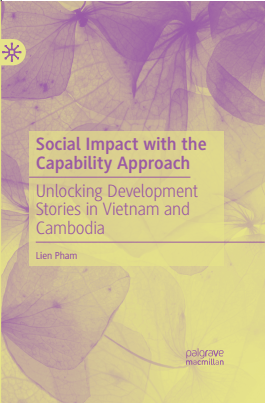
Social Impact with the Capability Approach: Unlocking Development Stories in Vietnam and Cambodia
Palgrave Macmillan, 2024
 Lien Pham