
Women’s empowerment is a complex thing.
Especially when it becomes woven into the infrastructure of development itself.
In WASH programs, involving women often appears not only appropriate, but obvious. Women are closely connected to water, hygiene, sanitation, childcare, household health, and everyday care work. They know the rhythms of households and communities. They know who is struggling, who is sick, who has no toilet, who walks furthest for water.
On the surface, then, using women as the frontline actors of WASH delivery seems sensible, efficient, even empowering.
And in many ways, it is.
The women in these projects gained confidence, knowledge, visibility, relationships, and greater participation in public life. Many became respected voices in their communities. Those gains are real and should not be dismissed.
But what happens when we examine this model more critically?
What does it mean when development projects succeed precisely because they rely on women’s existing burden of care?
That question stayed with me throughout my research in rural Vietnam and Cambodia.
The projects of delivering basic water, sanitation, & hygiene services to underserved rural communities were implemented in very different political contexts, yet the design was strikingly similar.
In Vietnam, the project worked through the Vietnam Women’s Union (VWU). In Cambodia, through the Commune Committee for Women and Children (CCWC).
The reason is that these women in their institutional roles are already embedded in communities. The mechanisms are: train them, mobilise them, then send them into households to convince people to build toilets, connect to water, wash their hands, care more about hygiene, care more about health, care more about one another.
And the women did it brilliantly.
A Vietnamese woman explained:
“When women go to meetings, they often share what they learned with others, but men don’t do it.”
Another Cambodian woman described how she regularly visited households:
“We have good communication with women and their family members. We have built close relationships with them and regularly visit their houses.”
There is something deeply moving about these women.
They walk from house to house under the heat. They sit with families. They explain menstruation, hygiene, diarrhoea, clean water, safety, dignity. They persuade poor households to build simple toilets from whatever materials they can afford.
One Cambodian woman explained what water meant to women:
“Women use water more than men. They use water for bathing, cooking, and washing cloth.”
Another spoke quietly about danger:
“Connecting piped water helps a lot for women… they used to face the problems of unexpected danger… they could get raped.”
The projects hit their targets of achieved WASH infrastructure delivery. Output indicators were achieved — latrines built, households connected, hygiene targets met.
The projects could also claim success in women’s empowerment.
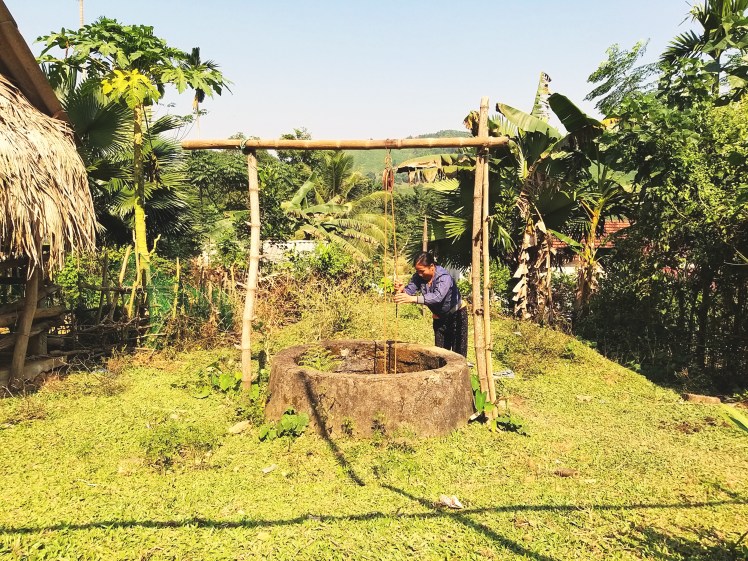
The Feminisation of WASH
But what if the very mechanism producing such development success of women’s’ empowerment was also reproducing gender inequality?
The projects succeeded because they relied on the feminisation of WASH itself.
Women became the emotional, social, and domestic labour force that made WASH systems accessible.
Women mobilised households.
Women carried behaviour change campaigns.
Women maintained trust networks.
Women absorbed the labour of care.
That is the contradiction sitting underneath both projects.
The projects did not create the assumption that hygiene, water, and care belong to women. Society already did that. The projects simply found those assumptions extremely effective for delivering results.
Women were trusted because they were already associated with sacrifice, caregiving, morality, and domestic responsibility.
In both countries, men rarely attended gender or hygiene meetings, as these village-level campaigns were still largely seen as “women’s issues.” As a result, women often attended in their place. In some cases, men were working far away for employment, leaving women to participate as the household representatives.
At first glance, this can look like women’s empowerment — women becoming more visible in public life, speaking at meetings, and taking leadership roles in their communities. But the reality is more complicated. Many women were not necessarily attending because they suddenly had more freedom or choices. Often, they attended because someone had to, and the responsibility naturally fell to them.
Over time, these extra responsibilities can become normalised. Women adapt, step in, and carry the work, not always because they freely chose it, but because social expectations and everyday realities leave little alternative. In this sense, what appears as empowerment can also reflect how women continue to absorb more unpaid community and care labour into their already busy lives.
For many VWU or CCWC women mobilisers, they did not even see their work as employment.
One woman said:
“There is no job opportunity in this project. This is my mission.”
Another explained:
“What we think about is how to support poor and near-poor households.”
There is dignity in those words. Real dignity.
There is collective duty in those words. Duty that the women owe to their community.
But there is also something deeply unsettling. The same qualities that made these women powerful community actors were also the qualities keeping them confined within socially acceptable forms of women leadership.
Women could lead hygiene campaigns because hygiene was still imagined as an extension of domestic femininity. They could speak about menstruation because menstruation belonged to the feminine sphere. They could mobilise households because households were still considered women’s domain.
Their empowerment existed — but often within boundaries already shaped by patriarchy, where women were expected to carry collective responsibility for family and community wellbeing in ways that continued to reinforce traditional gender roles.
Participation Is Not Freedom
Amartya Sen writes that development is about freedom — the real freedom to shape one’s life and become what one values.
That distinction matters. Because participation is not the same thing as freedom.
In both Vietnam and Cambodia, the projects counted women as “leaders” largely because they already occupied positions inside existing state or community structures.
The women were visible, active. They were everywhere. But power remained somewhere else.
One Cambodian woman recalled sitting in meetings where men simply ignored her:
“In the monthly meeting, they did not listen to my talk.”
Another described trying to ask for funding as a member of the Commune Council who has authority to do so:
“He acted as if he did not know we request for some budget.”
These women gained confidence, knowledge, relationships, and recognition as they progressed through their mobilisation journeys. Those gains were real. But the deeper structures of authority often remained intact. After all, it was usually men — their bosses or community leaders — who delegated them to take part in these projects, often because they were women and therefore seen as more suited to care and hygiene work, rather than because they were necessarily considered the most capable or best-qualified people for the role.
Budgets stayed elsewhere. Decision-making stayed elsewhere. Institutional power stayed elsewhere.
The burden of making development work, rested with women.
The Quiet Burden of Gender Equality
What troubles me most is not that women participated under the delegation of men or that they were unpaid because they felt a moral duty to carry out these tasks.
It is that gender equality itself increasingly seems to depend on women working harder.
The expectation is that women must mobilise more. Care more. Educate more. Volunteer more. Hold communities together more; and because this labour is wrapped in the language of empowerment, it becomes difficult to see the inequality sitting inside it.
Perhaps this is the paradox of contemporary gender mainstreaming.
The projects speak the language of leadership, participation, empowerment, and equality. Yet beneath the indicators, the logic often remains painfully familiar: women are still expected to carry the labour of sustaining everyday life.
Women become the invisible infrastructure of WASH.
And so I keep wondering: Is this what empowerment now looks like?
Is this the progressive face of development in the era of gender equality targets and women’s leadership indicators?
Or have we simply modernised the language of an old arrangement?
Because if WASH systems continue to function so effectively precisely because women absorb the unpaid labour of care, persuasion, emotional management, and social cohesion, then perhaps we are not witnessing the transformation of gender relations at all.
If we take a utilitarian perspective, we might say: well, these women achieved something significant for their communities. Underserved people gained access to WASH services they may not otherwise have received, and these women became more respected in their communities. Their organisations — often women organisations or women-led groups — also became better recognised for delivering this kind of work. Surely that is empowerment?
Maybe. But only if we accept that empowerment means empowering others more than yourself. Or that there is something noble about doing work that benefits the world while still maintaining the very social structures that place these responsibilities onto women in the first place.
As Amartya Sen reminds us, agency matters when people genuinely have the freedom to choose the lives they value. Yet many of these women were operating within already deeply gendered expectations about who should care, mobilise communities, and take responsibility for household wellbeing.
Judith Butler argues that gender norms are often reproduced through repeated social practices that come to feel natural and unquestioned. In this case, women’s participation in WASH mobilisation could simultaneously challenge and reinforce patriarchy: women became more visible and influential in public life, yet the labour itself remained tied to traditional ideas that care, hygiene, and community wellbeing are fundamentally women’s responsibilities.
In many ways, these women were carrying what feminist scholars have long described as the “double burden” — balancing unpaid domestic labour with growing public and community responsibilities — and sometimes even a “triple burden” that included income generation as well. I wondered whether I was witnessing not simply women’s empowerment, but the professionalisation of women’s burden.
This reflection draws on Chapters 5 and 8 of my book, Social Impact with the Capability Approach: Unlocking Development Stories in Vietnam and Cambodia. The book explores how development projects can simultaneously expand opportunities while reproducing deeper social inequalities through the lens of Amartya Sen’s Capability Approach.

