
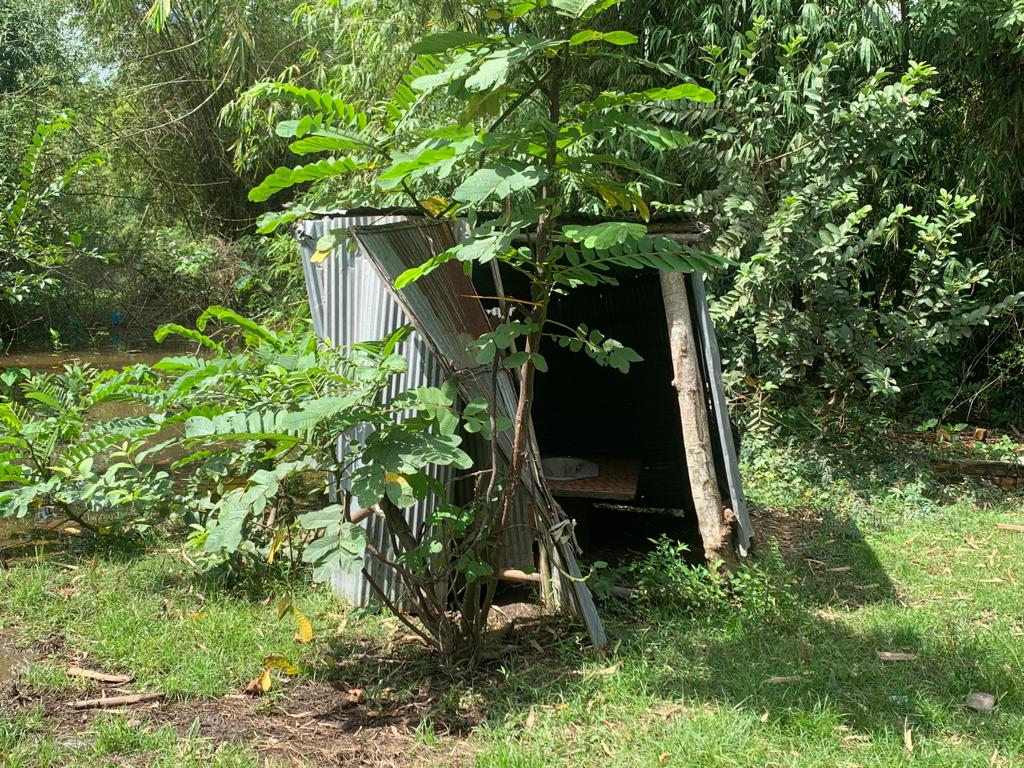
Sophea lives in a small village in rural Cambodia. Her house sits back from the road, surrounded by the everyday rhythms of village life—cooking, farming, children moving between houses, neighbours stopping to talk. Money is always carefully managed. Food comes first. Everything else has to fit around it.
Sophea’s grandmother has difficulty walking. Going to the toilet outside is becoming harder, particularly at night and during the wet season.
Then Sophea hears that a development project is providing subsidies to help poor households build latrines.
On paper, this sounds like exactly what her family needs. The subsidy makes the toilet cheaper.
But cheaper does not mean affordable.
There is still labour to pay for. Walls and a roof have to be built. If Sophea’s family wants something more than the simplest structure, they have to find the additional money themselves. And money spent on a toilet is money that cannot be spent somewhere else.
A village leader participating in my research described the dilemma faced by families like Sophea’s:
“Yes, the cost of latrines after subsidy is lower, but for poor people with disability, it’s very hard to save every small amount for each step for the construction of latrines. We need to buy food.”
And there is another problem.
The toilet being offered was designed to be affordable and relatively easy to construct across thousands of households. But a standard toilet is not necessarily an accessible toilet.
For someone like Sophea’s grandmother, who has difficulty walking, the entrance matters. The width of the space matters. Somewhere to hold on matters. The distance between the house and the toilet matters.
One person with disability told us:
“The latrines offered cannot suit wheelchairs and do not have enough space.”
Another participant described what an appropriate toilet would actually look like:
“Households with disabilities and elderly must provide latrines that can sit and fit well, and easy to enter with handled gates.”
Suddenly, something that looked straightforward—a poor household receiving a subsidy to build a toilet—becomes much more complicated.
Sophea’s family can be included in the project and still struggle to use what the project provides.
Beyond the numbers
I have been thinking about stories like Sophea’s while revisiting my research on rural water, sanitation and hygiene programs in Cambodia and Vietnam.
Development programs increasingly recognise the importance of social inclusion. We identify poor households. We disaggregate data by disability and gender. We count how many people from different groups have been reached.
These things matter.
In this Cambodia project, for example, more than 26,000 latrines were constructed for poor and vulnerable households, reaching almost 120,000 people. Disability was explicitly included as a vulnerability criterion. The project used Cambodia’s ID Poor system to identify households eligible for additional support.
Those numbers tell us something important about reach.
But walk through the village gate and sit with a family, and inclusion starts to look different.
A household may have received a subsidy but still have to borrow money from relatives to complete its toilet.
An elderly couple may qualify for assistance but still be unable to build because they cannot afford labour, walls and a roof.
A person with disability may technically have access to a toilet but be unable to enter it in a wheelchair.
A family may want an accessible toilet but discover that adaptations cost more—and that those additional costs are theirs to bear.
And a household can be desperately poor without appearing on the administrative list that determines who receives assistance.
These are not separate problems.
They accumulate in the same life.
People don’t live in categories
This is what I think we sometimes miss when we talk about “poverty inclusion” and “disability inclusion”.
Programs often need categories. They help us identify disadvantage, allocate resources and monitor who we are reaching.
People, however, do not live inside categories.
Imagine two people with the same physical impairment.
One lives in a household with a regular income. Her family can pay a mason to widen the toilet entrance, install handrails and build the facility close to the house. She has family members who can help her when she needs assistance.
The other lives in poverty. Her household worries about having enough food. There is no spare money for modifications. She may also be older, live without adult children nearby, or depend on irregular agricultural work.
Their disability might look the same in a monitoring spreadsheet.
Their possibilities are entirely different.
The same is true of poverty.
Two households may both be classified as poor, but one may have working-age adults, relatives who can lend money and strong connections within the village. Another may include an elderly person or a person with disability, have no reliable income and little family support.
Giving those households exactly the same thing does not necessarily give them the same opportunity.
People rarely talked about toilets as pieces of infrastructure.
They talked about what having a toilet allowed them to do.
One person wanted the toilet close to the house, away from insects, with somewhere to wash:
“I want to feel safe when I defecate. I also want to have a shower in the latrine so it’s convenient and not waste time.”
There is a whole life inside that sentence.
Safety. Privacy. Time. Comfort. Dignity.
These details can disappear when we reduce inclusion to whether infrastructure was delivered.
But they are precisely where inclusion is lived.
What would work for you?
Perhaps this is where we need to begin differently.
Instead of asking only whether a program has included poor people, people with disabilities, women or elderly people, we might ask:
What would it take for this particular person, living in this particular household and community, to benefit?
Sometimes the answer will be money.
Sometimes it will be accessible design.
Sometimes it will be information delivered in a different way.
Sometimes it will be transport, family support, a more flexible subsidy, a different technology, or simply being asked what would work.
Most often, it will be several of these things together.
Social inclusion needs to recognise this complexity. Poverty, disability, gender, age, geography and family circumstances do not arrive separately in people’s lives. They meet in ordinary, everyday decisions: whether to buy food or build a toilet; whether to attend a village meeting; whether to ask for assistance; whether a toilet can actually be entered and used safely.
What happens tomorrow?
Imagine that Sophea decides to take up the program.
She sits at a small table with a sheet of paper in front of her. Her grandmother stands beside her, one hand resting on the edge of the table.
Sophea begins to draw. First, a small square for the toilet. Then she makes the doorway wider. She draws a path from the house—not too far, her grandmother tells her. Inside, she adds something to hold onto.
Her grandmother points to the entrance.
Sophea looks at the drawing, rubs out a line and draws it again. Perhaps they add a place to wash. Perhaps they move the toilet closer to the house. Perhaps the path needs to be wider still.
For a moment, there is no “poor household” and no “person with disability”. There is just Sophea, her grandmother and a piece of paper between them, trying to imagine something that would work for the life they actually live.
Eventually, Sophea puts down her pencil.
Tomorrow, perhaps, she will take the drawing to the village meeting.
What happens to it there, we don’t know.
Perhaps someone will tell her the doorway costs too much. Perhaps the handrails are not covered by the subsidy. Perhaps the toilet must be built according to the standard design.
Or perhaps someone will pull up a chair, look at her drawing and ask her grandmother a question.
Sophea folds the paper carefully. Her grandmother is still standing beside her.
And tomorrow, they will find out whether there is room in the program for what they have drawn.
This post draws on Chapters 4 and 7 of my book, Social Impact with the Capability Approach: Unlocking Development Stories in Vietnam and Cambodia. The book explores how development projects can simultaneously expand opportunities while reproducing deeper social inequalities through the lens of Amartya Sen’s Capability Approach.

